
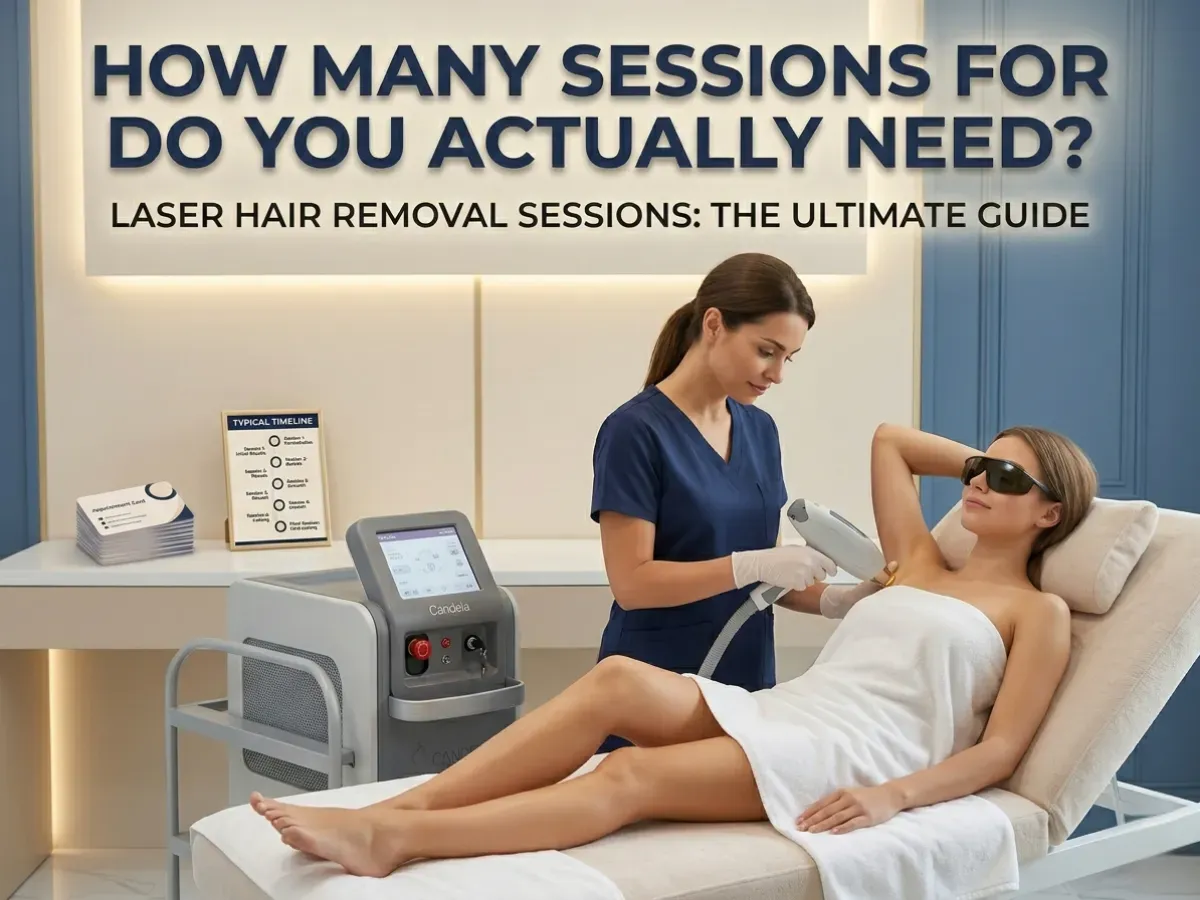
How Many Sessions for Laser Hair Removal Do You Actually Need?
Most people need 6 to 8 laser hair removal sessions to achieve significant, lasting hair reduction. Sessions are typically spaced 4 to 8 weeks apart, depending on the body area. However, your exact number can range from 4 sessions (underarms, fine hair) to 12 or more (hormonal areas like the face). Factors like hair colour, skin tone, the laser technology used, and underlying hormonal conditions all influence the final count. No two people respond the same way, which is why a proper skin and hair assessment before your first treatment matters as much as the treatment itself.
Laser Hair Removal Sessions by Body Area
Why You Cannot Do It in Just One or Two Sessions
Laser hair removal works by targeting the pigment (melanin) in a hair follicle and delivering enough heat to damage it permanently. The challenge is that it only works on actively growing hair, which puts us squarely in the territory of understanding hair growth cycles.
Every hair on your body cycles through three phases:
Anagen (active growth): This is the only phase in which the hair is attached to the follicle and contains enough melanin for the laser to target effectively.
Catagen (transition): The follicle begins to shrink and detaches from the blood supply. The laser has minimal impact here.
Telogen (resting): The hair sits dormant before shedding. A laser cannot treat it in this phase.
At any given moment, only roughly 20 to 30 percent of your hair is in the anagen phase. That means a single session can only treat a fraction of your follicles, no matter how thorough the treatment. Each subsequent session is timed to catch a new wave of follicles entering the active growth phase. This is not a workaround or a business tactic. It is the biological reality of how hair grows.
What Most Salons Recommend (and Why)
The industry-standard recommendation is 6 to 8 sessions for most body areas. After this initial course, the majority of clients see a 70 to 90 percent permanent reduction in hair density and thickness.
Sessions are spaced differently depending on the area being treated:
Face and bikini: Every 4 to 6 weeks, because facial and hormonal-zone hair tends to cycle faster.
Body areas like legs and back: Every 6 to 8 weeks, since hair cycles more slowly in these regions.
After completing the initial package, many clients schedule one or two maintenance sessions per year. This is not a failure of the treatment. Hormonal changes, medications, and simply the natural renewal of follicles over time can prompt a small percentage of dormant hairs to reactivate. A single annual touch-up keeps results looking clean.
At Panache Studio in Langley Township, our IPL laser treatments are spaced and structured around your specific growth cycle, not a generic calendar, because that is what actually drives results.
The Factors That Actually Determine Your Session Count
This is where generic advice falls apart. The 6- to 8-session guideline is a population average, not a personal prescription.
Skin Tone and Hair Colour
Laser technology targets the contrast between dark pigment in the hair and lighter pigment in the surrounding skin. The higher the contrast, the more effectively the laser can isolate and destroy the follicle.
Light skin with dark, coarse hair responds fastest and typically needs the fewest sessions.
Darker skin tones require longer-wavelength lasers (particularly Nd: YAG) to safely reach the follicle without affecting the surrounding skin. Treatment is still effective but may require more sessions to achieve the same outcome.
Blonde, grey, or red hair contains less melanin and is significantly harder to treat. Results are less predictable and often require more sessions with potentially lower overall efficacy.
Body Area
As the quick reference table shows, not all areas are equal. The face, particularly in women with hormonal triggers, tends to be the most treatment-resistant area. The upper lip may require 8 to 12 sessions, not because the laser is ineffective, but because the hormonal environment continues to stimulate new growth between sessions.
Underarms and lower legs, by contrast, respond quickly because hair density is lower and hormonal influence is minimal.
Hair Thickness and Density
Coarse, dense hair absorbs more laser energy per follicle, which would seem to make it easier to treat. In practice, dense areas often need careful, methodical passes to ensure full coverage. Fine hair, while it may need slightly more sessions because it contains less melanin, generally produces strong results over time.
Hormonal Factors
This is the variable that surprises most people. Conditions like PCOS (polycystic ovary syndrome), thyroid dysfunction, and general hormonal imbalances actively stimulate hair follicles. Even after successful treatment, a hormonal shift can wake dormant follicles that were never active during your sessions.
Suppose you have a diagnosed hormonal condition, plan for a higher session count and more frequent maintenance. Discuss this with your technician before starting treatment, because it should directly influence how they space and structure your plan.
Age and Genetics
Hair growth rate and follicle density are partly genetic. Someone with naturally dense, fast-growing hair will almost always need more sessions than someone with sparse, slow-growing hair, even if everything else is equal. Age also plays a role, as younger clients sometimes experience more active growth cycles.
The Laser Technology Being Used
Not all laser systems are created equal. The three most common technologies each have different strengths:
Diode laser: Highly effective on medium to dark skin, good penetration depth, widely used in professional clinics.
Alexandrite laser: Fast, effective on lighter skin tones, less suitable for darker skin.
Nd: YAG laser: The safest option for darker skin tones, though it may require more sessions to match the results achievable with Diode on lighter skin.
Older or lower-powered devices will naturally require more sessions to achieve the same follicle damage as a well-maintained, high-powered system. This is worth asking about before booking.
What "Permanent" Actually Means
The word "permanent" in laser hair removal advertising is technically accurate but easily misunderstood. The FDA classifies laser hair removal as producing "permanent reduction", not permanent removal.
What that means in practice:
After a full course of treatment, most clients see a 70 to 90 percent reduction in hair density.
The remaining hair is typically finer, lighter, and slower-growing.
A small percentage of follicles may recover or reactivate over time, particularly in hormonally sensitive areas.
Total, 100 percent, lifetime removal of every single hair is not a realistic expectation for the vast majority of people.
This is not a failure. Compared to a lifetime of waxing appointments, a 70 to 90 percent permanent reduction with light annual maintenance is an exceptional outcome. The key is going in with calibrated expectations, not marketing-inflated ones.
Red Flags That Should Make You Walk Away
The laser hair removal industry has its share of clinics that overpromise to close a sale. Here are specific warning signs:
Promises of full results in 3 sessions or fewer. Unless someone has extremely sparse hair in a non-hormonal area, this is not biologically plausible. A reputable clinic will give you a realistic range, not a suspiciously low number.
No skin or hair type assessment. Before your first session, a qualified technician should evaluate your Fitzpatrick skin type, hair colour and texture, and ask about any hormonal conditions or medications. Skipping this step is not just bad practice; it is a safety risk.
Unusually low package prices that do not add up. Clinics that cut session count to make packages appear affordable are not doing you a favour. You will end up paying for additional sessions later, often at a higher per-session rate, once you realize the initial package was insufficient.
No patch test before the first full session. A patch test 24 to 48 hours before treatment is standard safety protocol for new clients. Any clinic skipping this on your first visit should raise questions.
How to Get the Most Out of Every Session
Following the pre- and post-care protocol is not optional. It directly impacts how effective each session is.
Before your session:
Do not wax, thread, or use depilatory creams in the weeks leading up to your appointment. These methods remove the hair from the follicle, leaving nothing for the laser to target. Shaving 24 to 48 hours before your session is correct; shaving leaves the follicle intact while removing the surface hair.
Avoid sun exposure and tanning (including self-tanner) for at least two weeks before treatment. Tanned skin reduces the contrast between hair and skin pigment and increases the risk of skin reactions.
On your appointment day:
Arrive with clean, product-free skin on the treatment area. No deodorant for underarm sessions, no lotions or creams on legs or bikini areas.
Between sessions:
Do not wax between sessions. You can shave. If you notice that results seem inconsistent across a treated area, tell your technician before the next session so they can adjust coverage or settings.
Avoid excessive sun exposure between sessions, and use SPF 30 or higher on any treated areas exposed to the sun.
During your course of treatment:
Keep your appointments on schedule. Stretching sessions out too far can mean you miss the optimal window to treat hairs entering the anagen phase. If you need to reschedule, try to stay within a week or two of your original date rather than pushing significantly further out.
Communicate openly with your technician. If you are not seeing shedding (hair falling out 1 to 3 weeks post-session is a positive sign), or if certain patches seem unresponsive, that is useful clinical information. A good technician will adjust their approach rather than continue with the same settings session after session.
Conclusion
Most people need 6 to 8 laser hair removal sessions to achieve lasting results. Still, your specific count will depend on your skin tone, hair colour and texture, the body area being treated, hormonal factors, and the technology your clinic uses. Hormonal areas like the face often require 10 to 12 sessions, while simpler areas like the underarms can wrap up in 4 to 6.
Going in with realistic expectations matters. Laser hair removal delivers a permanent reduction, not guaranteed total removal. For the vast majority of people, that means 70 to 90 percent less hair, finer regrowth, and one or two maintenance sessions per year rather than a lifetime of waxing appointments.
The best starting point is a consultation with a qualified technician who will assess your skin and hair type, ask about your hormonal history, and give you an honest session estimate rather than the lowest number that will get you to sign up.
That conversation is what turns a generic guideline into a plan that actually works for you.